Dear Alumni and Friends,
All of us in the Program in Women’s, Gender, and Sexuality Studies (WGSS) at Washington State University hope this newsletter finds you staying healthy and safe.
Since launching the redesigned and renamed program in the fall of 2018, so much has happened! We’ve galvanized a group of more than 30 WGSS Affiliate Faculty from across the WSU system, convened two InQueery Symposia featuring student research and keynote speakers C. Riley Snorton (2018) and Leah Lakshmi Piepzna-Samarasinha (2019), and celebrated the work of Arshia Fatima Haq, the 2020 Jo Hockenhull Distinguished Visiting Artist. Haq’s exciting installation and lecture, co-sponsored by the Department of Fine Arts and the Center for Arts and Humanities at WSU, took place in early March on the Pullman campus, just days before the Stay Home, Stay Healthy order in Washington state.
WGSS faculty, graduate instructors, and students quickly came together to pivot to distance delivery for an extremely strong finish to the academic year. On April 22, we celebrated our graduates of 2020 and the academic and activist accomplishments of students, including Natalia Andrade, the WGSS Outstanding Senior major in women’s studies, and Alexia Gray, whose work for the Thurston County Prosecuting Attorney’s Office domestic violence sexual assault task force was recognized with a 2020 WGSS Internship and Community Service Award.
Summer courses were teeming with students who wanted to explore the questions that enveloped the country with the overlapping crises of COVID-19 and police violence. Not unlike other academic fields concerned with social justice or with foundations in social movements, and in alliance with the National Women’s Studies Association, WGSS issued a statement in solidarity with the Movement for Black Lives and renewing our commitment – as described on our home page since WGSS launched – to delivering the most relevant curriculum.
Ours are classes in which students analyze structural conditions intersectionally and craft solutions to problems with gender, sexual, and racial justice in clear view. To this end, on Thursday, October 15, InQueery 2020 participants will examine the theme of prison abolition; students will present their original scholarship and Andrea J. Ritchie, attorney, activist, and fellow at Barnard’s Center for Research on Women, will give the keynote address “Queer Dreams of Abolition Futures.” Everyone is welcome, so if you can make it, please do come (register via Zoom). Finally, several WGSS Affiliate Faculty recently wrote a letter to WSU administrators, signed by over 120 WSU faculty, which outlined concerns and recommendations for addressing gender and racial inequities laid bare and exacerbated by COVID-19 conditions.
With the experience of this spring and summer, and with the recent passing of that most resolute justice of the U.S. Supreme Court, Ruth Bader Ginsberg, we understand that the next year holds uncertainty, but know, without a doubt, that the work of WGSS has never been more important. We must begin imagining and building a future of “collective repair,” as the Movement for Black Lives has suggested. It is inspiring to see so many students in WGSS classes rising to the challenge, and I thank current majors and minors, alums, friends, and donors for their ongoing crucial support.
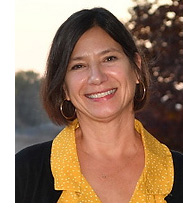
Pamela Thoma
Associate Professor and Director
Program in Women’s, Gender, and Sexuality Studies
Arshia Fatima Haq Named 2020 Jo Hockenhull Distinguished Visiting Artist
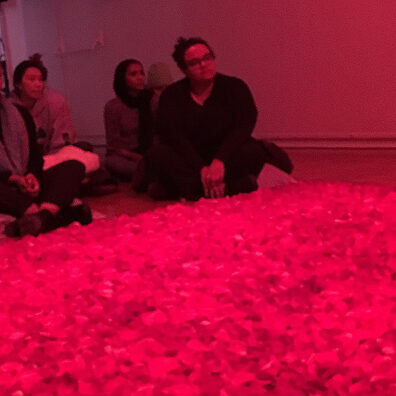
WGSS welcomed Arshia Fatima Haq to WSU in early March as the 2020 Jo Hockenhull Distinguished Visiting Artist. Haq held an installation/performance featuring a deep bed of red rose petals and presented an insightful lecture. Both events examined how archives and aesthetic production rooted in the Muslim world have been marginalized within conservative Islam and in the Western imagination. Past Hockenhull awardees include an array of visual artists, poets, and performance artists, including Octavia Butler, Coco Fusco, the Guerrilla Girls, Anna Chavez, Faith Ringgold, Jaune Quick-to-See Smith, Ayana Jackson, Marie Watt, and Jin-me Yoon.
InQueery 2019: Queering Disability
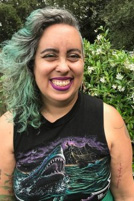
InQueery 2019 brought together WGSS faculty, students, and members of the WSU community to explore the event’s theme: Queering Disability: Dialogue and Change at the Intersections. WSU graduate and undergraduate students shared their findings and original research on gender, sexuality, and queering disability in presentation sessions that kicked off the conference. During her keynote address, Leah Lakshmi Piepzna-Samarasinha described her work as a queer disabled femme writer and disability justice movement worker.
National Period Day Rally
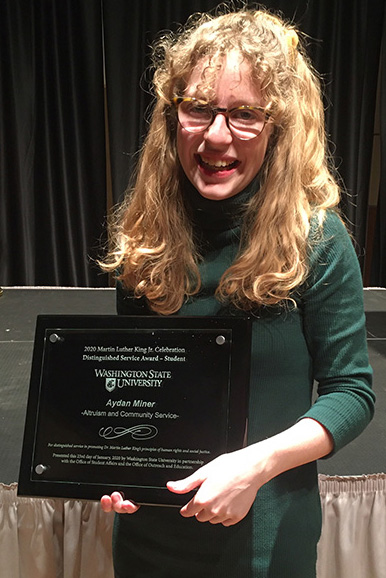
WSU’s PERIOD chapter traveled to Seattle to participate in the National Period Day rally, which brings awareness to period poverty and demands the end of the tampon tax. WSU’s PERIOD chapter is dedicated to serving the local community and has held packing parties and distributed period packs to homeless individuals in Pullman, Moscow, Spokane, and Seattle. Chapter president and WGSS minor, Aydan Garland-Miner, received WSU’s 2020 Martin Luther King, Jr. Distinguished Service Award for Altruism and Community Service for her work founding and organizing PERIOD.