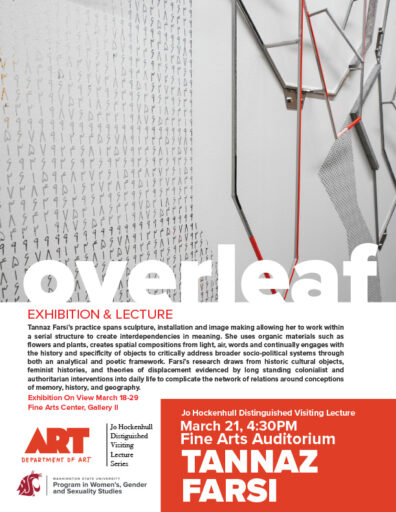
In March 2024, the Program in Women’s, Gender, and Sexuality Studies, the Fine Arts Department, and the Jordan Schnitzer Museum of Art at WSU hosted Tannaz Farsi, an Iranian-born American multidisciplinary visual artist and Associate Professor of Sculpture at the University of Oregon. Farsi was honored as the 2024 Jo Hockenhull Distinguished Visiting Artist. During her visit to the WSU-Pullman campus, Farsi joined WGSS instructors and students for lunch and conversation on March 20, and she gave a lecture titled “overleaf” in the Fine Arts Auditorium on March 21. After the title students, faculty, and staff enjoyed light refreshments and conversation with the artist at a reception sponsored by WGSS and the Department of art. Farsi’s exhibit, also titled “overleaf,” was also on display in the Fine Arts Center from March 18-29.
Farsi’s practice spans sculpture, installation, and image-making, which allows her to work within a serial structure to create interdependencies in meaning. She uses organic materials such as flowers and plants, creates spatial compositions from light, air, and words, and continually engages with the history and specificity of objects to critically address broader socio-political systems through both an analytical and poetic framework. Farsi’s research draws from historic cultural objects, feminist histories, and theories of displacement evidenced by longstanding colonialist and authoritarian interventions into daily life to complicate the network of relations around conceptions of memory, history, and geography. The Hockenhull lecture series was launched in 1996 by the Women’s Studies Department in collaboration with the Department of Fine Arts to honor Jo Hockenhull, a WSU emeritus professor of Fine Arts who served as director of Women’s Studies for more than a decade. At WSU, Hockenhull focused on building programs and initiatives supporting diversity, the liberal arts, free speech, and critical thinking. Like Farsi’s work, past lecturers have been artists whose work inspires and elicits the conneections between social justice and political practice with art. These have included Arshia Haq, Marie Watt, Faith Ringgold, The Guerrilla Girls, and Octavia Butler, among others.